
When Nazi Germany surrendered in May 1945, there was no single emotion shared by all Germans. The country was devastated, millions of people had lost relatives or homes, cities lay in ruins, and millions of refugees and displaced people were moving across Central Europe.
For many ordinary Germans, the first reaction was not political reflection but exhaustion and the struggle to survive. Feelings ranged from relief that the fighting had finally ended to fear, grief, uncertainty, resignation, anger, and cautious hope that life might eventually improve.

For Many Germans, the War Was Simply Over
By the spring of 1945, many Germans had already experienced years of bombing, military losses, food shortages, displacement, and the destruction of their communities.
The end of the war was therefore experienced differently across Germany. Civilians in towns occupied by American or British troops could have very different experiences from people in eastern Germany, where the advance of the Red Army produced intense fear and widespread upheaval.
For millions of civilians, the main question was no longer whether Germany could somehow continue fighting. It was whether they could find food, shelter, missing relatives, and somewhere safe to live.
Relief and Defeat Existed at the Same Time
The end of the war brought relief because the bombing, artillery fire, military conscription, and immediate danger of combat were finally ending.
But Germany had also suffered total military defeat. The Nazi government had collapsed, Allied troops occupied the country, and Germans had very little immediate control over their political future.
Some people were relieved that Hitler and the Nazi regime were gone. Others felt humiliation at Germany's defeat, while many were simply too focused on daily survival to spend much time thinking about politics.
The emotional situation was therefore complicated. Relief at the end of the fighting did not automatically mean enthusiasm for the occupying powers, just as resentment of occupation did not necessarily mean continued support for Nazism.
Survival Became the Main Concern
Germany's physical destruction shaped everyday life after the surrender.
Housing shortages were severe. Large numbers of homes had been destroyed or damaged by bombing and ground fighting. At the same time, millions of refugees and expellees arrived from territories in Eastern and Central Europe.
Food was another major concern. Rationing continued, shortages were common, and city residents often depended on barter, black markets, or journeys into the countryside to obtain additional food.
Contemporary surveys in the American occupation zone found that food, clothing, housing, employment, and concern for missing prisoners of war or relatives were among the most pressing problems facing ordinary Germans.
Ruins Were Part of Everyday Life
Post-war Germany became associated with images of bombed-out cities and civilians clearing debris.
Berlin, Dresden, Hamburg, Cologne, and many other cities contained enormous areas of destruction. Railways, bridges, factories, utilities, and housing all required reconstruction.
Daily life nevertheless began returning surprisingly quickly in some areas. Shops reopened where possible, local transport gradually resumed, and people tried to rebuild routines around the ruins.
Yet beneath this return to normality remained enormous uncertainty about food, employment, housing, missing relatives, and Germany's political future.
How Did Germans View the Allied Soldiers?
Attitudes toward the occupying forces varied greatly.
Some Germans initially regarded Allied soldiers mainly as conquerors. Others gradually associated the Western Allies with food aid, security, and the possibility of rebuilding a more stable life.
Experiences also differed between the four occupation zones controlled by the United States, Britain, France, and the Soviet Union.
There was no sudden moment in May 1945 when every German adopted the same attitude toward the victors. Opinions changed unevenly over the following years.
What About Responsibility for Nazi Crimes?
One of the most difficult questions facing post-war German society concerned responsibility for the crimes committed by Nazi Germany.
The Allied occupation authorities pursued denazification and attempted to confront the German population with evidence of concentration camps, persecution, mass murder, and the Holocaust.
Reactions were mixed. Some Germans rejected Nazism and acknowledged the crimes of the regime. Others claimed ignorance, emphasized their own wartime suffering, or resisted ideas of collective responsibility.
The process through which German society confronted the Holocaust and other Nazi crimes developed over decades rather than being completed in 1945.
Political Apathy Was Common
After twelve years of dictatorship followed by catastrophic military defeat, many Germans were politically exhausted.
For many families, questions about democracy or Germany's future political system could feel less urgent than finding enough food for the week or learning whether a missing husband, son, father, or brother was still alive.
This did not mean political life disappeared. New political parties, newspapers, and local governments began emerging under Allied supervision, but rebuilding politics happened alongside the much more immediate struggle to survive.
The Situation Slowly Began to Change
By the late 1940s, attitudes in the western occupation zones were beginning to change as the developing Cold War transformed the relationship between Germans and the Western Allies.
Nowhere was this shift more visible than in Berlin.
The Berlin Blockade Changed West Berlin
In June 1948, the Soviet Union blocked major road, rail, and canal routes into the western sectors of Berlin.
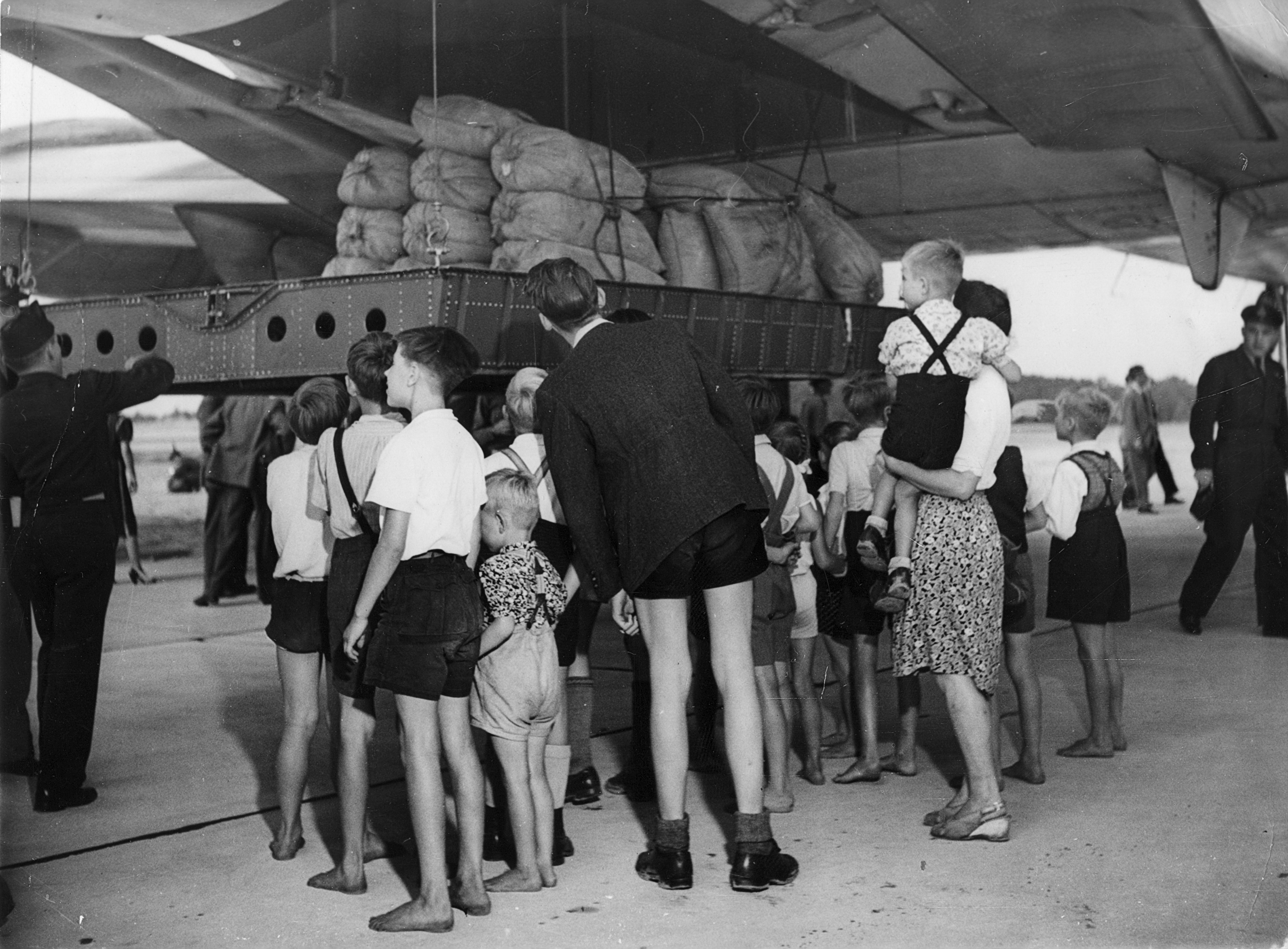
The United States and Britain responded with the Berlin Airlift, flying food, coal, medicine, and other essential supplies into the isolated western sectors of the city.
The operation became one of the defining events of the early Cold War.

This is the original picture from your existing post.
For many West Berliners, the Airlift changed how the Western Allies were perceived. Only a few years earlier, American and British aircraft had bombed German cities. Now Allied aircrews were flying around the clock to keep West Berlin supplied.
In September 1948, around 300,000 West Berliners gathered near the Reichstag to demonstrate against Soviet pressure and in support of remaining connected to the Western sectors.
The Airlift helped strengthen the idea that the Western powers were no longer simply occupying forces but increasingly partners in the defense of West Berlin.
The Candy Bombers Became a Powerful Symbol
One of the most famous stories of the Berlin Airlift involved American pilot Gail Halvorsen.
After meeting German children near Tempelhof Airport, Halvorsen began dropping small packages of chocolate and chewing gum attached to handmade parachutes.
The idea developed into what became known as Operation Little Vittles. Other pilots and volunteers joined the effort, and large quantities of sweets were eventually distributed to Berlin's children.

The candy drops were tiny compared with the millions of tons of food, coal, and other supplies carried during the Airlift, but their symbolic value was enormous.
German children who had recently associated American aircraft with wartime bombing were now seeing American pilots as people bringing food, sweets, and hope.
From Occupiers to Allies
The Berlin Airlift did not instantly erase wartime memories or make every German pro-American.
However, it played an important role in changing attitudes in West Berlin. The developing Cold War increasingly made the United States, Britain, and France appear not simply as Germany's former enemies and occupiers but as powers willing to protect the western sectors of the city.
This transformation was particularly strong in West Berlin and the western occupation zones. Developments in the Soviet occupation zone followed a very different political path.
So How Did Germans Actually Feel After the War?
The most accurate answer is that Germans felt many different things at the same time.
Some felt relief that the killing had ended. Others mourned relatives, homes, and communities. Refugees worried about where they would live. Former soldiers and their families wondered whether prisoners of war would return home.
Millions struggled with hunger and shortages. Some Germans rejected Nazism, while others remained influenced by ideas from the previous regime. Some feared Allied soldiers, while others gradually began to regard the Western powers as partners in rebuilding Germany.
There was no single national emotion and no single moment when German attitudes suddenly changed.
Conclusion
Immediately after World War II, most Germans were living through one of the most uncertain periods in their country's history. Germany had been defeated, divided, and occupied. Cities were devastated, families were separated, millions of people were displaced, and obtaining food and shelter could dominate daily life.
The emotions of 1945 included exhaustion, fear, grief, relief, resignation, and cautious hope. Political attitudes were equally complicated and changed only gradually.
Over the following years, Germany's relationship with the Western Allies began to transform. The Berlin Airlift of 1948–49 became one of the clearest symbols of that change. In West Berlin especially, former wartime enemies increasingly came to be regarded as allies willing to supply and defend the city.
The story of German attitudes after 1945 is therefore not simply a story of defeat or gratitude. It is the story of a population moving from war and dictatorship through occupation, hardship, displacement, and uncertainty toward a completely different political and social order.
Sources: Deutsches Historisches Museum; German History in Documents and Images; U.S. Department of State Office of the Historian; U.S. Air Force historical records.

Memories of WW2 for me, based in London, with various interludes of evacuation, first during the blitz, which I barely remember, but again later in the war when the doodlebugs and later still the V2 rockets made an appearance, to the Tonneypandy valley in Wales where I briefly went to school. Blackouts, shelters, bomb sites interrupting row houses, boring and unchanging food, porridge in the winter, beetawicks in the summer, powdered eggs, curtesy of the Americans, fear on the nights that bombing came down with a whistle that occasionally would last longer than others and consequently produce an even bigger explosion. Never ending nightly news where the names of German cities being bomed in clipped British accents would be announced, Essen, Dortmund, Duisburg and the like, a veritable geography lesson from the BBC. The strong sense of the awfulness of the other side, culminating in sitting in the cinema and my mother trying ineffectually to cover my eyes when the horrors of Belsen were revealed on the newsreel. The sense that the Red Army was invincible, the Americans were wonderful, the RAF and the British Army were so obviously winning the war as last few months and even the last couple of years of the war played out and the relief that brought that’s one’s Dad would in fact be coming back and that the German language would not be taking over.
In terms of physical comfort following the end of the war things really didn’t improve much, stringent food rationing, damaged and broken infrastructure and bomb sites everywhere. My family was evicted from our rented house in favor of the owner's son returning from military service, and we all had to move to a “rest center” a euphemism for homeless shelter, where we stayed for about five months while searching for accommodation in world turned upside down. Musical houses in London following the war where vacancies were nearly impossible to find. Freezing cold winters with the family surrounding the one fireplace that was in use, with the heat mostly going up the chimney. Fairly harsh conditions that lasted for a long time after the war had ended. Without doubt, europeans on the continent had it much worse, particularly, and unsurprisingly, the Germans themselves. Actually it could be said that effects of relative hardship and scarcity are by no means all bad, it does provide an education of sorts, which the hot house kids growing up today don’t experience and often get knocked down once they encounter the inevitable adversities of life. Well that turned into something of a moralizing rant, but that’s some small part of my memory of the period.
As a long time WW2 history fanatic who is much too young to have experienced any of wars hardships growing up in California I found this nothing short of an amazing firsthand summary of the experiences that truly painted a picture. Thank you