
On 28 June 1914, two gunshots in Sarajevo helped set Europe on the road to the deadliest war the world had yet experienced.
Archduke Franz Ferdinand, heir to the Austro-Hungarian throne, and his wife Sophie were assassinated by Gavrilo Princip, a Bosnian Serb nationalist.
Only a little more than a month later, Europe's major powers were at war.
That makes the assassination look like the simple cause of World War I—but it was really the spark, not the complete explanation.
Europe in 1914 was already divided by military alliances, nationalism, imperial rivalries, arms races, fear of neighboring powers, and repeated crises in the Balkans. The assassination created a diplomatic emergency—the July Crisis—and political leaders then made a series of decisions that transformed a conflict between Austria-Hungary and Serbia into a European and eventually global war.
The Short Answer: Why Did World War I Start?
World War I began because a regional crisis in the Balkans collided with a much larger system of European rivalry.
Austria-Hungary wanted to punish Serbia after the assassination of Franz Ferdinand. Germany promised strong support to Austria-Hungary. Russia mobilized in support of Serbia and to protect its own interests in the Balkans. Germany responded by declaring war on Russia and France, then invaded Belgium as part of its plan for fighting a two-front war.
Britain then entered the conflict.
None of these decisions occurred in isolation. The major European powers had spent years preparing for the possibility of a large war.
Europe Was Already Under Pressure Before 1914
The decades before World War I were not simply peaceful years suddenly interrupted by one assassination.
Europe's great powers competed for influence, military strength, territory, colonial possessions, and prestige.
Germany had become a powerful unified state only in 1871 and rapidly developed into one of Europe's greatest industrial and military powers.
France remained deeply concerned about Germany and had not forgotten the loss of Alsace-Lorraine after the Franco-Prussian War.
Russia wanted greater influence in the Balkans and presented itself as a supporter of Slavic peoples such as the Serbs.
Austria-Hungary feared nationalist movements that threatened its multinational empire.
Britain became increasingly concerned about Germany's growing power, particularly the expansion of the German navy.
These rivalries did not make war inevitable—but they created an environment in which a major crisis could become extremely dangerous.
The Alliance System Divided Europe
By 1914, Europe's major powers were linked through alliances and understandings.
Germany and Austria-Hungary were close allies. Italy was formally part of the Triple Alliance with them, although Italy did not immediately join their war in 1914 and later entered the conflict on the Allied side.
France and Russia had formed an alliance, while Britain had developed close diplomatic understandings with France and Russia.
Together, Britain, France, and Russia became associated with the Triple Entente.

It is tempting to imagine these alliances as an automatic machine: one country goes to war and every ally is instantly forced to join.
The real situation was more complicated.
Political leaders still had choices. Britain, for example, was not automatically required by a simple alliance clause to enter every French or Russian war. Italy demonstrated that alliances did not always determine exactly what a country would do.
But the alliance system increased the danger because every government had to consider how its actions would affect powerful partners and rivals.
Nationalism Made the Balkans Especially Dangerous
Nationalism was another major source of tension.
Across Europe, people increasingly identified themselves with nations defined by language, ethnicity, history, and culture.
This could strengthen established states such as France or Germany.
But nationalism was particularly dangerous for multinational empires such as Austria-Hungary, which contained Germans, Hungarians, Czechs, Slovaks, Croats, Serbs, Romanians, Poles, Ukrainians, Slovenes, Italians, and other groups.
In the Balkans, Serbia hoped to expand its influence among South Slavic peoples.
Austria-Hungary considered Serbian nationalism a serious threat to the stability of its empire.
Bosnia Was at the Center of the Tension
Austria-Hungary formally annexed Bosnia and Herzegovina in 1908.
The region contained a substantial South Slavic population, including many Serbs.
Serbian nationalists strongly opposed Austro-Hungarian control.
Some radical nationalists dreamed of bringing South Slavic territories together in a larger state free from Habsburg rule.
This was the environment in which Franz Ferdinand visited Sarajevo in June 1914.
The Assassination of Archduke Franz Ferdinand
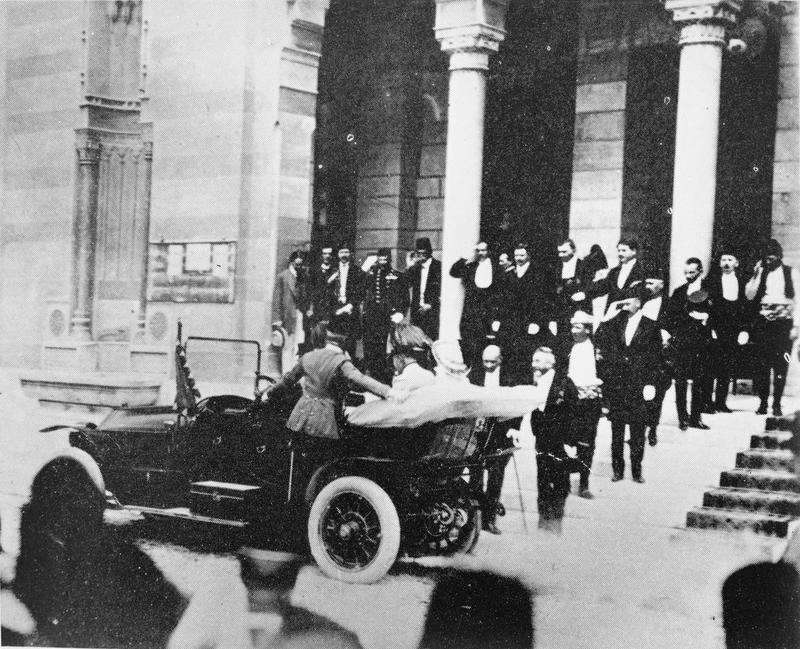
On 28 June 1914, Franz Ferdinand and Sophie visited Sarajevo.
A group of young Bosnian Serb nationalists prepared to attack the Archduke's motorcade.
An initial bomb attack failed to kill him.
Later that day, after a change and confusion in the motorcade route, the Archduke's car came close to Gavrilo Princip.
Princip fired two shots.
Franz Ferdinand and Sophie both died.
The assassination shocked Europe—but even then, a continent-wide war did not have to follow automatically.
Why Did Austria-Hungary Blame Serbia?
Austro-Hungarian leaders believed Serbian nationalism threatened the empire and viewed the assassination as an opportunity to confront Serbia.
The relationship between the Serbian government and the assassination plot remains historically complex.
Princip and his fellow conspirators were Bosnian Serb nationalists, and individuals connected to Serbian nationalist and military networks assisted the plotters.
But that is not the same as proving that the Serbian government as a whole ordered the assassination.
Austria-Hungary nevertheless decided that Serbia had to be punished.
Germany Gives Austria-Hungary the “Blank Check”
Before acting against Serbia, Austria-Hungary wanted to know whether Germany would support it if Russia intervened.
In early July, German leaders gave Austria-Hungary strong assurances of support.
This became known as Germany's “blank check.”
The promise mattered enormously.
Austria-Hungary now knew that if its confrontation with Serbia expanded into a conflict with Russia, Germany was prepared to stand behind its ally.
This encouraged Vienna to take a much harder position.
The Austro-Hungarian Ultimatum to Serbia
On 23 July 1914, Austria-Hungary delivered an ultimatum to Serbia containing a series of demands related to anti-Austrian activity and the investigation of the assassination.
Some demands were extremely difficult for a sovereign government to accept completely.
Serbia accepted many of the demands but did not agree to everything in the form Austria-Hungary required.
Austria-Hungary declared the Serbian response insufficient.
On 28 July 1914, Austria-Hungary declared war on Serbia.
A Local War Begins to Expand
If the conflict had remained limited to Austria-Hungary and Serbia, there would have been no world war in 1914.
The decisive problem was that Russia did not intend to watch Serbia be defeated without responding.
Russia had strategic interests in the Balkans and regarded itself as a major protector of Slavic interests.
Russian leaders therefore began military preparations and mobilization.
Germany viewed Russian mobilization as an immediate military threat.
Why Was Mobilization So Dangerous?
Military mobilization in 1914 was not simply an announcement that a country was angry.
It involved calling millions of reservists, moving troops by railway, distributing equipment, organizing supply systems, and deploying armies according to detailed plans.
Once mobilization began, governments feared that stopping or delaying it would leave their armies dangerously vulnerable.
Railway schedules and war plans created enormous pressure for speed.
Political leaders therefore found themselves making decisions while military timetables were already moving.
Germany Declares War on Russia
Germany demanded that Russia halt its military mobilization.
Russia did not comply in the way Germany demanded.
On 1 August 1914, Germany declared war on Russia.
Now a confrontation that had begun between Austria-Hungary and Serbia directly involved two of Europe's greatest military powers.
Why Did France Become Involved?
France was allied with Russia.
Germany expected that a war against Russia would also mean war against France.
German military planning had long been shaped by the danger of a two-front conflict—France in the west and Russia in the east.
Germany therefore planned to concentrate heavily against France first before shifting forces eastward.
On 3 August 1914, Germany declared war on France.
Why Did Germany Invade Belgium?
The German plan for rapidly defeating France required German armies to advance through neutral Belgium.
Belgium refused Germany's demand for passage.
German troops invaded Belgium on 4 August.
This decision dramatically expanded the crisis.
Britain had strategic interests in preventing a hostile great power from dominating the Channel coast and was also committed to Belgian neutrality.
On 4 August 1914, Britain declared war on Germany.
Within days, the original Austro-Serbian conflict had become a general European war.
Did Alliances Cause World War I?
They were an important factor, but saying “alliances caused the war” is too simple.
Alliances shaped how governments interpreted threats and made a local crisis more likely to spread.
But leaders still made specific political and military decisions during July and August 1914.
Austria-Hungary chose a hard confrontation with Serbia.
Germany encouraged Austria-Hungary and later chose war against Russia and France.
Russia chose mobilization to defend its position and interests.
France supported its Russian ally.
Britain eventually chose intervention after Germany invaded Belgium and the European balance of power was threatened.
The system created danger; decisions turned danger into war.
What Role Did Militarism Play?
Europe's great powers maintained enormous armies and increasingly sophisticated weapons before 1914.
Military spending had risen, conscription produced millions of trained reservists, and governments developed detailed plans for rapid mobilization.
Britain and Germany also competed in a major naval arms race.
Military power became deeply connected to national prestige.
This did not mean generals secretly controlled every government or that weapons themselves caused the war.
But it meant that when the crisis arrived, governments already possessed huge military systems designed to mobilize and fight quickly.
The Naval Arms Race Increased British-German Rivalry
Germany's decision to build a powerful battle fleet particularly alarmed Britain.
For Britain, naval superiority was essential to national security, imperial communications, and trade.
Germany's naval expansion therefore encouraged Britain to view German power with greater suspicion.
The naval race was one reason Britain moved closer diplomatically to France during the years before the war.
Imperial Rivalries Added More Tension
European powers also competed for colonies and international influence.
Germany, France, and Britain clashed diplomatically during the Moroccan crises of 1905 and 1911.
These crises did not cause World War I directly.
But they increased distrust and pushed Britain and France toward closer cooperation.
Each crisis convinced governments that another great-power confrontation might occur in the future.
The Balkan Wars Made the Situation Worse
The Balkans experienced major wars in 1912 and 1913, only shortly before the assassination at Sarajevo.
The Ottoman Empire lost much of its remaining territory in Europe.
Serbia emerged stronger, increasing anxiety in Austria-Hungary.
Russia's interest in Serbia and Austria-Hungary's fear of Serbian influence created a particularly dangerous rivalry.
By 1914, European diplomats already knew that another Balkan crisis could pull larger powers into conflict.
Was the Assassination Really the Cause?
The best description is that it was the immediate trigger.
Without the assassination, the specific July Crisis of 1914 might not have happened.
But killing Franz Ferdinand did not mechanically force Germany to invade Belgium or Britain to declare war.
The assassination created a crisis.
The deeper tensions of European politics made the crisis dangerous.
The decisions made by governments during the following five weeks turned it into a world war.
Could World War I Have Been Avoided?
Probably—at several points.
Austria-Hungary could have accepted negotiations after Serbia's response to the ultimatum.
Germany could have pressured Vienna toward restraint rather than offering strong support.
Russia might have limited its mobilization differently.
German leaders might have avoided expanding the conflict into Belgium and France.
Other diplomatic proposals might have been given more time.
But each government feared that backing down could weaken its security or prestige.
The crisis became especially dangerous because leaders increasingly believed that acting first was safer than waiting.
Did Everyone Expect a Four-Year Disaster?
No.
Many political and military leaders expected a much shorter conflict.
European war plans emphasized rapid offensives and decisive battles.
Instead, the Western Front eventually hardened into trench systems stretching across Belgium and France.

Industrial warfare produced artillery bombardments, machine-gun fire, barbed wire, poison gas, submarines, aircraft, and enormous casualties.
A crisis that began in the Balkans eventually drew soldiers and resources from Europe, Africa, Asia, the Middle East, North America, Australia, New Zealand, and other parts of the world.
Who Was Responsible for Starting World War I?
This remains one of the most debated questions in modern history.
It is too simple to claim that a single country alone explains everything that happened before 1914.
Serbian nationalism, Austro-Hungarian fears, Russian policy, German strategy, French commitments, British interests, imperial rivalries, and military planning all formed part of the background.
But responsibility for the final escalation was not necessarily equal.
Historians continue to debate the degree of responsibility carried by Austria-Hungary, Germany, Russia, Serbia, France, Britain, and individual political leaders during the July Crisis.
The National WWI Museum notes that historians continue to debate exactly how responsibility should be distributed among the major states involved.
A Simple Timeline of the July Crisis
28 June 1914: Archduke Franz Ferdinand and Sophie are assassinated in Sarajevo.
Early July: Germany gives Austria-Hungary strong assurances of support.
23 July: Austria-Hungary delivers its ultimatum to Serbia.
25 July: Serbia responds, accepting many but not all demands.
28 July: Austria-Hungary declares war on Serbia.
Late July: Russia begins major military mobilization measures.
1 August: Germany declares war on Russia.
3 August: Germany declares war on France.
4 August: German forces invade Belgium; Britain declares war on Germany.
In little more than five weeks, an assassination in Sarajevo had become a European war.
Frequently Asked Questions
Did Franz Ferdinand's assassination directly cause World War I?
It triggered the July Crisis, but deeper causes included great-power rivalry, nationalism, military planning, alliances, imperial competition, and instability in the Balkans.
Who killed Archduke Franz Ferdinand?
Gavrilo Princip, a Bosnian Serb nationalist, shot Franz Ferdinand and his wife Sophie in Sarajevo on 28 June 1914.
Why did Germany support Austria-Hungary?
Austria-Hungary was Germany's key European ally. German leaders feared losing their ally and gave Vienna strong backing during the crisis with Serbia.
Why did Russia support Serbia?
Russia had strategic interests in the Balkans and saw itself as a supporter of Slavic peoples. Allowing Austria-Hungary to dominate Serbia could weaken Russian influence.
Why did Britain enter World War I?
Germany's invasion of neutral Belgium was an immediate trigger, while Britain's broader concerns included the European balance of power and the danger of German domination of the Channel coast.
Was World War I inevitable?
No. Europe was extremely tense, but governments still made choices during the July Crisis. Different decisions could potentially have prevented or limited the conflict.
Conclusion
World War I did not begin because of one assassination alone.
The murder of Archduke Franz Ferdinand was the spark that ignited a European system already under enormous strain.
Nationalism made the Balkans unstable. Austria-Hungary feared Serbia. Russia wanted influence in southeastern Europe. Germany feared encirclement and supported Austria-Hungary. France was committed to Russia. Britain was increasingly concerned about German power.
Military alliances, arms races, imperial rivalries, and detailed mobilization plans made every decision during the July Crisis more dangerous.
When Austria-Hungary chose war against Serbia, Russia mobilized, Germany declared war on Russia and France, and German troops entered Belgium, the crisis expanded faster than diplomacy could contain it.
The deeper lesson is that World War I was not caused by a single event. It began when long-term tensions combined with short-term decisions made by governments that feared weakness, distrusted their rivals, and believed military action might solve their problems.
Instead, Europe entered a war lasting more than four years and reshaping the modern world.
If you want to follow how Europe's unresolved tensions later contributed to another global conflict, explore ThinkAIWorld's World War II articles.
Sources
Library of Congress — Echoes of the Great War
Library of Congress — Origin of the War
National WWI Museum and Memorial — Origins of World War I
