
In the summer of 1940, Britain stood in a dangerous position.
France had fallen. German forces controlled much of Western Europe. The British Army had escaped from Dunkirk but left behind large quantities of equipment, and Adolf Hitler ordered preparations for a possible invasion of Britain—Operation Sea Lion.
Before any invasion could have a realistic chance, however, Germany needed to neutralize the Royal Air Force and gain air superiority over southern England and the English Channel.
The Luftwaffe appeared to have major advantages. It had experienced pilots, powerful fighters and bombers, combat experience from Poland and France, and airfields spread across the newly occupied coast of Western Europe.
Yet by the autumn of 1940, Germany had failed to destroy RAF Fighter Command.
Why?
The Battle of Britain was not decided by the Spitfire alone, by radar alone, or because German pilots were ineffective. Britain survived because an entire defensive system—radar, observers, command-and-control networks, fighter squadrons, aircraft production, repair organizations, airfields, and pilots—worked together. At the same time, Germany suffered from limited fighter range, confused strategic priorities, intelligence errors, and a bombing campaign that failed to destroy Fighter Command before shifting its focus.

What Was Germany Trying to Achieve?
After the defeat of France in June 1940, Britain remained at war with Germany.
Hitler authorized preparations for Operation Sea Lion, the proposed invasion of England.
But moving an invasion force across the English Channel would be extremely dangerous while the Royal Navy remained powerful and RAF fighters could attack German ships and landing forces.
The Luftwaffe therefore received a crucial mission: weaken or destroy RAF Fighter Command sufficiently to gain freedom of action over southern England and the Channel.
The RAF Museum's history of Operation Sea Lion notes that failure to achieve air supremacy eventually forced Hitler to postpone the invasion indefinitely.
The Battle Was About More Than Shooting Down Aircraft
It is easy to imagine the Battle of Britain as one long series of dogfights between Spitfires and Messerschmitts.
Those air battles were important, but the real contest was larger.
Germany was trying to destroy Britain's ability to defend its airspace.
That meant attacking aircraft in the air, airfields on the ground, radar stations, aircraft factories, ports, and other parts of the British defense network.
Britain, meanwhile, did not need to conquer Germany in 1940.
Fighter Command only had to remain strong enough that Germany could not confidently control the air over an invasion zone.
That difference in objectives mattered.
Britain Had Built an Integrated Air-Defense System Before the War
One of Britain's greatest advantages existed before the first major German raids began.
Under Air Chief Marshal Hugh Dowding, Fighter Command had developed an integrated air-defense organization often called the Dowding System.
Radar was only one part of it.
The system combined information from Chain Home radar stations, the Royal Observer Corps, intelligence sources, operations rooms, telephone networks, sector stations, and fighter squadrons.
Incoming raids could be detected, tracked, assessed, and then met by fighters sent toward the most useful interception point.
This allowed Britain to use a limited fighter force much more efficiently than if squadrons simply patrolled the sky waiting to find German aircraft by chance.
Radar Gave Britain Time
Britain's Chain Home radar network could detect many German formations approaching across the sea.
The RAF Museum states that Chain Home could detect aircraft at ranges of up to about 200 miles under favorable conditions.
That early warning mattered because fighters did not need to remain airborne all day.
They could wait on the ground, receive instructions, scramble, climb, and intercept an incoming raid.
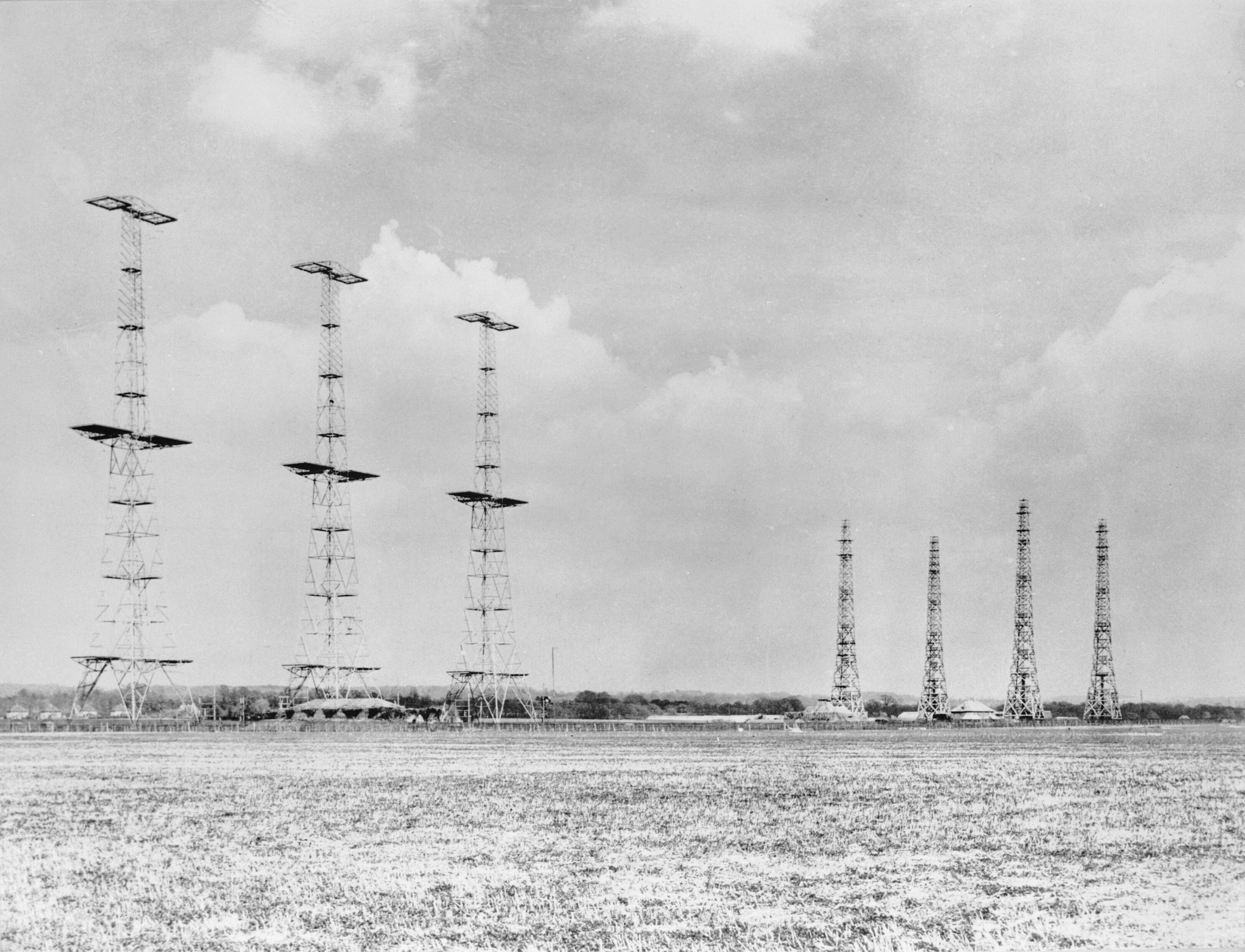
Radar was not perfect.
The system had difficulty following aircraft once they moved inland, and low-flying aircraft could sometimes evade the main Chain Home coverage.
That is why the Royal Observer Corps remained essential.
Human observers continued tracking German formations visually after they crossed the coast.
Radar Alone Did Not Win the Battle
This point is important.
Britain's advantage came from turning radar information into useful decisions.
A radar contact was passed through a command network where raid information was assessed and plotted.
Controllers could then decide which fighter squadrons should scramble, how many were needed, and where they should go.
The Luftwaffe knew Britain possessed radar, but German commanders did not fully appreciate how deeply it was integrated into the entire Fighter Command system.
Germany attacked radar sites during parts of the battle, but the campaign against the network was not sustained strongly enough to destroy Britain's warning system.
Britain Was Fighting Over Its Own Territory
Geography gave Fighter Command another advantage.
A British pilot shot down over southern England might parachute to safety, receive medical treatment, and eventually return to his unit.
A German pilot shot down over Britain was likely to be killed or captured.
The same applied to aircraft.
Damaged RAF fighters could sometimes make emergency landings at friendly airfields and be repaired.
German aircraft damaged over England faced a long flight back across the Channel.
This meant that apparently similar daily losses did not always have the same long-term effect on both sides.
The Messerschmitt Bf 109 Had a Range Problem
The Bf 109 was a dangerous fighter and in many situations comparable to the Spitfire and Hurricane.
But during operations over southern England, its endurance became a serious limitation.
German fighter bases were across the Channel in France and the Low Countries.
Bf 109 pilots had to spend fuel reaching Britain, fighting, escorting bombers, and then returning home.
Deep over England, the amount of time available for combat could be limited.
British fighters, by contrast, were operating close to their own bases.
They could often spend more of their fuel where the actual battle was taking place.
German Bombers Needed Fighter Protection
Luftwaffe bombers such as the Heinkel He 111, Dornier Do 17, and Junkers Ju 88 could carry the war to British targets.
But bomber formations were vulnerable to RAF fighters.
German fighters therefore had to protect them.
This created a tactical problem.
If fighter pilots were ordered to remain tightly attached to bomber formations, they could lose some of the altitude, speed, freedom of movement, and surprise that made fighters most effective.
If they ranged too far ahead, the bombers could be exposed.
German fighter pilots and bomber commanders did not always agree on the best solution.
The Spitfire Was Famous—but the Hurricane Was Crucial
The Supermarine Spitfire became the most iconic aircraft of the Battle of Britain.
Its speed, performance, and elegant design made it ideal for popular memory.
But the Hawker Hurricane was equally central to Fighter Command's success.
Hurricanes equipped a large share of the RAF fighter squadrons during the battle and were responsible for engaging large numbers of German aircraft.

The Spitfire and Hurricane were complementary rather than simply competitors.
Both aircraft benefited from operating inside Britain's larger air-defense network.
An excellent fighter aircraft is much more useful when its pilot knows where the enemy is likely to appear.
British Aircraft Production Was Stronger Than Germany Expected
Germany did not simply need to shoot down some RAF fighters.
It had to reduce Fighter Command faster than Britain could replace aircraft and repair damaged machines.
Britain's aircraft industry continued producing fighters throughout the campaign.
Repair organizations also returned damaged aircraft to service.
This meant German estimates of RAF strength could become badly misleading.
British losses were serious, but destroyed aircraft were being replaced more effectively than German intelligence often assumed.
Pilots Were More Difficult to Replace Than Aircraft
Aircraft could be produced in factories.
A trained fighter pilot required time.
By late summer 1940, pilot shortages and exhaustion became one of Fighter Command's most serious problems.
The RAF shortened parts of the training process and moved new pilots into combat units rapidly.
The Royal Air Force notes that during the battle the average RAF fighter pilot was very young, and training for replacements became extremely compressed during the emergency.
Experienced squadron leaders therefore had to integrate young pilots while continuing to fight multiple sorties.
The RAF Was an International Force
The phrase “The Few” is often associated mainly with British pilots.
But Fighter Command's battle was international.
Pilots came from Poland, Czechoslovakia, Canada, New Zealand, Australia, South Africa, and other countries, as well as Britain.
The RAF states that roughly one-fifth of the airmen who flew during the Battle of Britain were not British.
Polish and Czechoslovak pilots were especially important because many already had combat experience before arriving in RAF squadrons.
The Luftwaffe Initially Attacked Shipping and Coastal Targets
The battle developed in phases.
During the early fighting, German aircraft attacked shipping in the English Channel, ports, coastal targets, and some airfields.
These attacks served several purposes.
They damaged British shipping, tested defenses, forced Fighter Command to respond, and allowed the Luftwaffe to learn how the British system operated.
By August, however, Germany increased the scale of attacks against Fighter Command itself.
August 1940 Put Fighter Command Under Enormous Pressure
In mid-August, the Luftwaffe launched large attacks intended to break British air defenses.
Airfields and sector stations became major targets.
This was a dangerous period for Fighter Command.
RAF Museum material notes that attacks between late August and early September seriously damaged several forward airfields and sector stations.
The idea that German attacks were having no effect is therefore wrong.
Fighter Command was under genuine pressure.
The Luftwaffe Also Suffered Heavy Losses
German planners expected Fighter Command to weaken rapidly.
Instead, British fighters continued appearing.
From 26 August to 6 September, RAF Museum figures give RAF losses of 248 aircraft compared with 322 Luftwaffe aircraft.
The exact strategic effect cannot be understood from raw aircraft totals alone, because the types of aircraft and crews lost mattered.
A German bomber might carry several trained aircrew, while a British single-seat fighter carried one pilot.
German crews captured over Britain were permanently removed from the battle.
German Intelligence Misjudged Fighter Command's Strength
One of the Luftwaffe's major problems was determining whether its campaign was actually succeeding.
German pilots made combat claims, intelligence officers estimated British production, and commanders tried to calculate how many fighters remained.
Those estimates were often inaccurate.
German commanders repeatedly believed Fighter Command was closer to collapse than it actually was.
This affected strategic decisions.
If a commander believes the enemy has only a small number of fighters left, continued attacks may seem likely to finish the job.
If the estimate is wrong, the strategy becomes built on false expectations.
The Luftwaffe Failed to Destroy Fighter Command's Control System
Britain's sector stations were especially important because they helped direct fighter squadrons.
Some were attacked and seriously damaged.
But the German campaign did not systematically destroy the network before changing priorities.
Even damaged British installations were often repaired quickly or worked around.
The air-defense system bent under pressure but did not collapse.
Why Did Germany Start Bombing London?
At the end of August 1940, German bombs accidentally fell on parts of London during attacks aimed elsewhere.
Britain then carried out bombing raids against Berlin.
Hitler responded angrily and German strategy increasingly shifted toward major attacks on London.
But the switch should not be reduced to Hitler's anger alone.
German leaders also believed attacks on London might draw RAF fighters into a decisive battle, damage British morale, disrupt government and industry, and place additional pressure on the country.
The strategic shift nevertheless had an important consequence.
Fighter Command's heavily pressured airfields and sector system received breathing space.
The Shift to London Helped Fighter Command Recover
The RAF Museum describes the early September shift away from sustained attacks on fighter airfields as a major error by Hermann Göring.
Fighter Command had been under severe strain.
When the Luftwaffe concentrated increasingly on London and other urban targets, British fighter bases remained under threat but were no longer facing the same concentrated campaign.
That allowed damaged facilities to be repaired and exhausted squadrons to continue functioning.
It did not make the air battle easy.
But Germany had changed objectives before destroying the system that stood between the Luftwaffe and air superiority.
September 15 Became Battle of Britain Day
On 15 September 1940, the Luftwaffe launched major raids against London.
RAF Fighter Command committed large numbers of aircraft against the attacks.
The German raids failed to produce the destruction of Fighter Command that Luftwaffe leaders hoped for.
The day later became celebrated in Britain as Battle of Britain Day.
Strategically, the continuing ability of the RAF to meet large German formations demonstrated that British fighter defenses remained operational.

Germany Could Not Achieve Air Superiority
By September, it was increasingly clear that Fighter Command had not been destroyed.
German bombers could still strike Britain, and the Blitz would continue for months.
But bombing cities was not the same as controlling the skies well enough to protect an invasion fleet crossing the English Channel.
Without clear air superiority—and with the Royal Navy still a major threat—Operation Sea Lion remained extremely risky.
The invasion was repeatedly postponed and never launched.
Was the Battle Won Because the Spitfire Was Better Than the Bf 109?
No single aircraft comparison explains the result.
The Spitfire and Bf 109 were both highly capable fighters.
Each had advantages depending on altitude, speed, tactical position, and model.
The Hurricane was also a major part of Britain's fighter force.
The outcome depended less on finding one “best plane” than on which side could keep aircraft fueled, repaired, directed, crewed, and placed in the right part of the sky.
For more on WWII pilot combat and fighter tactics, explore ThinkAIWorld's Military Aviation section.
Did Radar Make British Pilots Automatically Win Dogfights?
No.
Radar did not shoot down German aircraft.
It gave British commanders information.
The fighter pilots still had to take off, find the raid, survive German escorts, attack the bombers, and return safely.
Radar's real advantage was efficiency.
It helped Fighter Command avoid wasting limited aircraft on endless standing patrols and improved the chance that fighters would meet raids at useful times and places.
Did Germany Lose Because It Bombed London Instead of Airfields?
The change of target was important, but saying it alone lost the Battle of Britain is too simple.
Even before the shift, the Luftwaffe had not destroyed Britain's radar network, aircraft production, fighter organization, or pilot force.
German fighter range remained limited.
Aircraft and aircrew losses were accumulating.
Intelligence estimates remained inaccurate.
Bombing London reduced pressure on key Fighter Command infrastructure, but it was one factor inside a larger strategic failure.
Could Germany Have Won the Battle of Britain?
Historians continue to debate alternative German strategies.
A more sustained campaign against sector stations and fighter infrastructure might have placed Fighter Command under even greater pressure.
More accurate intelligence might have improved German decisions.
Different fighter tactics might have reduced some disadvantages.
But Germany still faced difficult structural problems: limited fighter endurance over Britain, losses of trained bomber crews, the resilience of British production and repair, the integrated Dowding System, and the continuing strength of the Royal Navy.
So a different strategy might have changed the battle, but British defeat was never guaranteed.
The Battle Was Not Won by Britain Alone
Britain's ability to continue fighting also depended on the wider British Empire and Commonwealth, foreign pilots, industrial workers, ground crews, radar operators, observers, mechanics, anti-aircraft units, and many others.
The famous fighter pilots were only the most visible part of a national defense system.
An RAF aircraft could not fly without mechanics.
A squadron could not intercept effectively without information.
A damaged airfield could not recover without ground organizations repairing runways, communications, fuel systems, and equipment.
Why the Battle of Britain Mattered So Much
The battle was the first major campaign in which Nazi Germany failed to achieve its central military objective.
Britain remained in the war.
That meant Germany still faced an active enemy off the coast of occupied Europe.
Britain later became a base for the strategic bombing campaign, the buildup of American forces, and eventually the D-Day invasion of 1944.
Germany's inability to force Britain out of the war therefore had consequences far beyond the summer and autumn of 1940.
For the wider conflict, explore ThinkAIWorld's World War II section.
Frequently Asked Questions
When was the Battle of Britain?
The official British dates are generally 10 July to 31 October 1940, although the wider air campaign against Britain continued afterward during the Blitz.
Why did Germany need air superiority over Britain?
Germany needed to reduce the threat from RAF fighters before attempting an invasion across the English Channel. Without air superiority, German landing forces and shipping would have been exposed to RAF attacks as well as the Royal Navy.
How important was radar?
Radar was extremely important because it provided early warning, but its power came from being integrated with observers, operations rooms, communications networks, controllers, and fighter squadrons.
Was the Spitfire the main RAF fighter?
The Spitfire was extremely important and became the iconic aircraft of the battle, but Hawker Hurricanes also formed a major part of Fighter Command and played a crucial role.
Why couldn't the Bf 109 stay over Britain longer?
The fighter had to fly from bases across the Channel, escort bombers, fight, and retain enough fuel to return. This limited the time Bf 109 pilots could spend in combat over deeper parts of southern England.
Did Hitler lose the Battle of Britain because he bombed London?
The shift toward London reduced pressure on Fighter Command's airfield system and helped the RAF recover, but Germany's failure resulted from several factors, including radar and command integration, fighter range, intelligence errors, British production, pilot replacement, and Luftwaffe losses.
Did Germany ever launch Operation Sea Lion?
No. The planned invasion was repeatedly postponed after Germany failed to gain the required air superiority and was never carried out.
Were all Battle of Britain pilots British?
No. The RAF was an international force. Pilots from Poland, Czechoslovakia, Canada, New Zealand, Australia, South Africa, and other countries fought alongside British airmen.
Conclusion
Germany lost the Battle of Britain because it failed to destroy the system that kept RAF Fighter Command fighting.
The Luftwaffe possessed experienced crews, capable aircraft, and major numerical strength, but Britain had built an unusually effective defensive network.
Chain Home radar provided warning. The Observer Corps tracked raids inland. Operations rooms turned information into decisions. Fighter controllers sent squadrons where they were needed. Ground crews repaired aircraft. British factories replaced losses. Pilots from Britain and many other countries continued flying despite exhaustion and heavy casualties.
Germany faced its own limitations.
Bf 109 fighters had restricted endurance over Britain. Bomber formations needed protection. German intelligence repeatedly underestimated RAF strength. Radar and control installations were not destroyed systematically. Luftwaffe losses continued to remove experienced aircrew.
Most importantly, Germany changed the focus of its bombing campaign before Fighter Command had been defeated.
Major attacks on London caused terrible destruction, but they did not produce the air superiority required for Operation Sea Lion.
By the autumn of 1940, the RAF was battered but still operational.
That was enough.
Britain did not need to destroy the Luftwaffe completely. It only needed to prevent Germany from controlling the skies over the Channel and southern England.
Fighter Command succeeded—and Germany's planned invasion never took place.
For more aircraft-focused history, visit ThinkAIWorld's Aircraft section.
Sources
RAF Museum — Radar: The Battle Winner?
RAF Museum — How Radar Worked and the Dowding System
RAF Museum — Battle of Britain Phase Three
RAF Museum — Operation Sea Lion
Royal Air Force — Battle of Britain
