
For millions of men who fought in World War II, the war was not experienced from a map room, a cockpit, or the bridge of a warship.
It was experienced at ground level.
For an infantry soldier, that could mean walking for hours under a heavy load, digging into frozen earth, sleeping in mud, eating cold field rations, waiting through artillery fire, losing friends, receiving replacements he barely knew, and then moving forward again.
Hollywood often compresses infantry combat into a few dramatic minutes. Real front-line life was usually a mixture of short bursts of extreme violence and much longer periods of exhaustion, discomfort, uncertainty, waiting, and fear.
Conditions varied enormously between Normandy, Italy, the Ardennes, North Africa, and the Pacific islands. There was no single “average day” that describes every soldier. But official U.S. Army histories, wartime photographs, medical studies, and veterans' accounts reveal several experiences that repeatedly defined infantry life.

Infantry Soldiers Lived Closest to the Battlefield
Every military depended on artillerymen, engineers, truck drivers, mechanics, medics, signal troops, cooks, quartermasters, airmen, sailors, and many other specialists.
But the infantry's basic job placed riflemen directly on the ground where territory was captured, defended, or lost.
Infantrymen had to move toward enemy positions, patrol areas where enemy troops might be hidden, occupy exposed defensive lines, and remain close enough to the enemy to use rifles, machine guns, grenades, mortars, and other short-range weapons.
That made infantry service exceptionally dangerous.
One U.S. Army wartime analysis from the Italian campaign found that infantrymen made up a relatively small share of total Army personnel in the theater but suffered a disproportionately large share of casualties.
The exact percentages varied by campaign and period, but the larger pattern was clear: rifle companies were repeatedly depleted by combat and needed a constant flow of replacements.
There Was No Universal “Life Expectancy” for a WWII Infantryman
A popular internet claim says that a front-line infantryman's life expectancy was only a few days, weeks, or even minutes.
There is no reliable universal figure like that.
A soldier's chance of becoming a casualty depended on his unit, job, theater, campaign, time at the front, and intensity of combat.
A rifleman involved in repeated attacks could face much greater danger than a soldier in the same army serving behind the front. A division in a quiet sector could experience very different conditions from one fighting through Normandy, the Hürtgen Forest, or Okinawa.
What official records do show is that prolonged heavy combat could consume infantry manpower at an extraordinary rate.
A postwar U.S. Army estimate cited in Army historical research stated that during periods of intensive combat an infantry division could suffer cumulative losses in its infantry regiments equivalent to roughly their entire strength within about three months.
That did not mean every original soldier was killed. “Casualties” included killed, wounded, missing, captured, and other losses, while replacements continuously entered the unit.
A Soldier Could Join a Unit Without Knowing Anyone
The American replacement system often sent individual replacements forward to units that had already suffered casualties.
Some new soldiers arrived after moving through a chain of replacement depots with little connection to the men they would eventually fight beside.
Official Army history described replacements reaching front-line areas tired, uncertain, and aware from the sound of nearby guns that they were about to enter combat.
When casualty pressure was intense, units did not always have enough time to integrate new soldiers slowly.
A replacement might be assigned to a squad, learn a few names, receive quick instructions from veterans, and soon find himself under fire.
This could be dangerous because combat survival depended on habits that were difficult to learn in training alone: when to move, where to take cover, how to recognize incoming fire, how much equipment to carry, and when not to expose yourself.
Combat Was Often Mostly Artillery, Mortars, and Machine Guns
World War II films frequently show soldiers firing rifles at clearly visible enemies.
That happened, but infantrymen were also threatened by weapons they might never see.
Artillery shells and mortars could arrive suddenly from beyond visual range.
Machine guns could cover roads, fields, or gaps in hedgerows. Mines and booby traps made apparently empty ground dangerous. Snipers could make simple movement risky.
Soldiers learned that survival often depended on terrain.
A ditch, stone wall, shell hole, tree line, embankment, ruined building, or fold in the ground could become lifesaving cover.
In Normandy, Hedgerows Turned Fields Into Fortresses
After D-Day, American forces advancing through Normandy encountered the dense bocage: small fields divided by ancient earthen banks topped with thick hedges.
These obstacles limited visibility and made it difficult to see what was waiting in the next field.
German defenders could position machine guns, riflemen, mortars, and anti-tank weapons behind the hedgerows.
For infantrymen, advancing through this terrain could mean clearing one field and then facing another defensive position only a short distance away.
Progress measured on a map might look tiny, yet every hedgerow could require another dangerous attack.
Soldiers Carried More Than Just a Rifle
A rifleman needed ammunition, grenades, water, food, entrenching tools, clothing, first-aid equipment, gas masks during some periods, personal items, and whatever additional equipment his mission required.
The exact load changed constantly.
Soldiers often learned quickly that every unnecessary object became heavier after hours of marching.
U.S. Army Quartermaster records from Normandy noted that infantrymen sometimes discarded overcoats, blankets, overshoes, and other equipment while fighting through hedgerow country because mobility mattered more than comfort in the immediate battle.
The problem came later when rain, cold, or a static front suddenly made those abandoned items essential.
Food Was Designed for Mobility, Not Pleasure
Whenever possible, field kitchens provided more substantial meals.
But soldiers in active combat often had to rely on packaged field rations.
The U.S. Army used several types, including C-rations, K-rations, 10-in-1 rations, and the emergency D-ration.
The lightweight K-ration was convenient for troops who had to carry their own food, but it was never intended to be an ideal long-term diet.
Quartermaster history records that soldiers complained about repetition and monotony when K-rations were used for extended periods.
Hot food and especially hot coffee could therefore become unusually important morale boosters.
Eating Could Be a Luxury During an Attack
Combat did not stop because it was breakfast or dinner time.
Men sometimes ate whenever there was an opportunity: in a foxhole, beside a road, inside a ruined building, or during a brief pause in movement.
Rations might be cold if fires were unsafe or kitchens could not reach the front.
In fast-moving campaigns, supply units struggled to keep up with infantry formations advancing miles beyond their previous positions.
Ammo and water could become more urgent than hot meals.

Sleep Was Often Broken and Unpredictable
Front-line soldiers could go long periods without normal sleep.
Night was often the time for patrols, digging, sentry duty, ammunition delivery, unit movement, and enemy attacks.
Even when a soldier technically had time to sleep, artillery, aircraft, cold, insects, rain, fear, or the need to remain alert could prevent real rest.
Some men learned to sleep whenever a safe opportunity appeared—even for only a few minutes.
Exhaustion accumulated over days and weeks.
The Foxhole Could Become a Soldier's Home
Infantry soldiers repeatedly dug fighting positions because digging increased the chance of surviving shell fragments, bullets, and surprise attacks.
A shallow position could be improved into a deeper fighting hole if time allowed.
On a static front, soldiers might reinforce positions and develop more elaborate shelters.
But a foxhole was not comfortable.
Rain could fill it with water. Snow could freeze around it. Insects could make tropical positions miserable. Bodies, waste, mud, and damaged equipment sometimes surrounded defensive lines after heavy fighting.
Still, a hole in the ground could feel safer than almost anywhere else.
Weather Could Be Almost as Dangerous as the Enemy
World War II was fought in deserts, mountains, jungles, frozen forests, tropical islands, and flooded fields.
Infantrymen had to operate in all of them.
In Europe, rain turned roads and fields into mud. Winter brought freezing temperatures, snow, frostbite, and wet clothing.
During the Battle of the Bulge, some U.S. units fought through deep snow and severe cold while supply lines were disrupted.
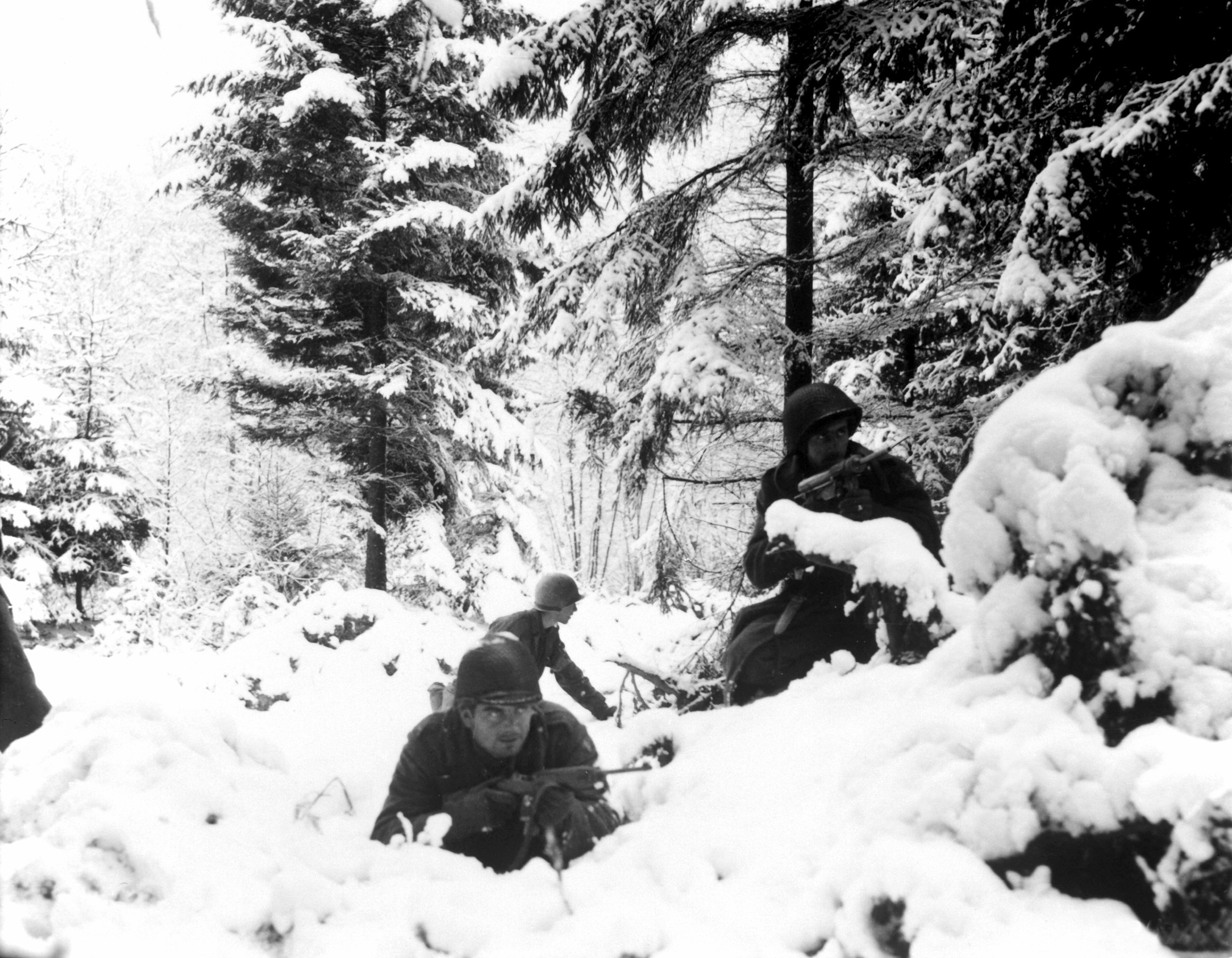
Cold weather could damage feet, reduce weapon reliability, complicate vehicle movement, and make ordinary tasks painfully difficult.
A soldier could not simply stop fighting because his clothing was wet or his hands were numb.
The Pacific Created a Completely Different Kind of Misery
Infantry life in the Pacific could involve extreme heat, humidity, tropical rain, dense vegetation, insects, contaminated water, and disease.
Guadalcanal became infamous for malaria, dysentery, shortages, poor diet, and the psychological pressure of jungle combat.
The U.S. Army's medical history of the Pacific noted that lack of sleep, enemy infiltration, night attacks, insects, skin disease, and the environment itself contributed to psychological strain.

For more on the island campaigns, see ThinkAIWorld's Pacific War articles.
Disease Could Remove Soldiers Without a Bullet Being Fired
Illness was a major military problem, especially in tropical theaters.
Malaria, dysentery, skin infections, and other diseases could weaken units and send soldiers to hospitals.
Medical services therefore fought a second war against infection, insects, sanitation problems, and environmental exposure.
Preventive medicine, clean water, insect control, and field sanitation were not secondary comforts. They directly affected how many soldiers remained physically capable of fighting.
Fear Was Normal
Combat veterans were not men who never felt fear.
They were men who learned to function while afraid.
The danger could come from artillery without warning, enemy patrols at night, an unseen machine gun, a mine, or an attack that everyone knew was coming the next morning.
Waiting could be especially difficult because soldiers had time to imagine what might happen.
Experienced troops developed routines that helped them cope: checking equipment, digging deeper, talking with friends, smoking, eating when possible, and focusing on immediate tasks.
Combat Exhaustion Was Real
World War II armies used terms such as battle fatigue, combat exhaustion, and war neurosis for psychological breakdown associated with prolonged combat stress.
Symptoms varied. Soldiers could become confused, shake uncontrollably, lose the ability to function, experience severe anxiety, or behave unpredictably.
Military doctors gradually learned that many cases were reactions to prolonged exposure rather than evidence of cowardice.
Rest, food, sleep, warmth, and treatment near the front could sometimes return men to duty, while more severe cases required evacuation.
Friendship Was Often More Immediate Than Grand Strategy
Governments fought World War II for enormous political and strategic objectives.
But at rifle-squad level, motivation could become much more personal.
Soldiers depended on the men around them for warning, covering fire, ammunition, first aid, and sometimes simple reassurance.
A veteran might continue moving because his squad needed him, not because he was thinking about a speech made months earlier by a national leader.
This is one reason casualties could be so disruptive.
When experienced men were killed or wounded, a unit did not only lose numbers. It lost friendships, confidence, practical knowledge, and established teamwork.
Replacements Changed the Social Life of a Unit
A new replacement entered a difficult environment.
Veterans might hesitate to become close to newcomers because earlier friends had already been killed or wounded.
The replacement, meanwhile, needed experienced soldiers to teach him the unwritten rules of survival.
Over time, if he survived, he could become one of the veterans teaching the next replacement.
This cycle repeated continuously in heavily engaged infantry formations.
Casualties Could Transform a Unit in Weeks
The manpower crisis became particularly serious for the U.S. Army in Europe after Normandy.
Army planners had underestimated how many infantry replacements would be required.
Official Army research shows that by the second half of 1944, replacement requirements had risen dramatically as infantry regiments absorbed casualties during continuous operations.
Soldiers from other specialties were retrained as infantry, and training programs were adjusted to provide more riflemen.
The problem became so severe that late in the European war, African American volunteers from service units were organized into infantry platoons and attached to previously white combat units.
The Army itself remained segregated, but the emergency showed how urgently infantry replacements were needed.
Being Wounded Did Not Always Mean the Battle Was Over
Medical evacuation depended on where a soldier was wounded and whether medics could reach him.
Buddy aid and combat medics were the first link in a chain that might move a casualty from the battlefield to an aid station, clearing station, field hospital, and eventually a larger hospital farther to the rear.
Modern antibiotics, blood plasma, improved surgery, evacuation systems, and organized medical support saved many lives.
But evacuation under fire remained dangerous.

Letters From Home Mattered Enormously
Mail connected soldiers with ordinary life.
Letters from parents, wives, girlfriends, siblings, and friends reminded men that another world still existed beyond the battlefield.
Packages might contain food, cigarettes, photographs, socks, or small personal comforts.
Units that had been fighting for days could place enormous value on something as simple as clean clothing, a hot shower, or a letter.
Soldiers Rarely Stayed at Maximum Intensity Forever
Front-line life was not always continuous shooting.
Units rotated positions, rested when circumstances allowed, moved to reserve areas, reorganized, trained, repaired equipment, and absorbed replacements.
A soldier might spend days under fire and then several quieter days waiting for the next move.
The rhythm depended on the campaign.
This is another reason claims about a single “average” infantry experience are misleading.
Why Did Infantrymen Keep Fighting?
There was no one answer.
Some believed deeply in the cause.
Some wanted revenge after enemy attacks or the deaths of friends.
Some feared punishment for abandoning their duty.
Many relied on training and habit.
And many veterans later emphasized loyalty to the small group around them.
The soldier beside you was depending on you, and you were depending on him.
The Infantryman's Equipment Was Only Part of His Survival
Rifles, machine guns, helmets, radios, artillery support, tanks, and aircraft all mattered.
But survival also depended on judgment.
Veterans learned not to stand where a silhouette could be seen against the sky.
They learned to dig quickly.
They listened for the difference between incoming and outgoing fire.
They learned where enemy machine guns were likely to be positioned and how to move without exposing themselves unnecessarily.
This battlefield knowledge was difficult to write into a manual because much of it came from experience.
Not Every Soldier Experienced the Same War
A soldier landing at Omaha Beach experienced a different war from a Marine on Guadalcanal.
A rifleman freezing in Belgium experienced a different war from a soldier fighting in the heat of Sicily.
Even men in the same division could remember the war differently depending on when they joined, whether they were wounded, what job they performed, and which battles they survived.
That is why the phrase “what was World War II like for a soldier?” has no single simple answer.
The closest answer is that infantry life combined physical discomfort, intense danger, long periods of waiting, dependence on comrades, and constant adaptation to the environment.
What Movies Usually Get Wrong
War films often have to compress weeks of military life into a few hours.
That can make combat appear more continuous than it usually was.
Movies also tend to focus on visible gunfights because they are easier to dramatize than exhaustion, supply problems, artillery harassment, digging, waiting, disease, replacement shortages, and the gradual psychological effects of prolonged danger.
Those less dramatic factors were often central to the real infantry experience.
For more World War II ground-combat history, explore ThinkAIWorld's World War II section.
Frequently Asked Questions
What was life like for a World War II infantry soldier?
It varied by theater and campaign, but common experiences included long marches, heavy loads, field rations, foxholes, poor sleep, weather exposure, artillery fire, fear, strong dependence on comrades, and periods of intense combat separated by waiting and movement.
How long did an infantry soldier survive in World War II?
There was no universal life-expectancy figure. Risk varied enormously by unit, campaign, job, and time spent in combat. Some infantrymen were casualties on their first day, while others fought through multiple campaigns and survived the war.
Were most soldiers constantly fighting?
No. Front-line service included combat, but also patrols, guard duty, digging, movement, resupply, waiting, training, and periods in reserve.
What did American infantrymen eat?
When field kitchens were unavailable, soldiers commonly used packaged rations such as C-rations, K-rations, and 10-in-1 rations. The K-ration was lightweight and convenient but became unpopular when used for extended periods.
Did infantry soldiers sleep in foxholes?
Yes, especially when holding exposed front-line positions. Depending on the situation, soldiers also slept in buildings, trenches, dugouts, tents, vehicles, or simply wherever temporary cover was available.
What caused most stress for infantry soldiers?
Enemy fire, artillery, mines, night attacks, sleep deprivation, casualties among friends, weather, disease, uncertainty, and prolonged exposure to danger all contributed to combat stress.
Why were infantry replacement shortages so serious?
Infantry units suffered heavy casualties during sustained combat. Because rifle companies were repeatedly depleted, armies needed a constant flow of trained soldiers to keep formations at effective strength.
Conclusion
Life as an infantry soldier in World War II was much more than the moments of combat usually shown in films.
The infantryman's war was physical.
He marched, carried, dug, froze, sweated, waited, ate whenever food arrived, slept whenever circumstances allowed, and learned to treat small pieces of cover as matters of life and death.
It was also psychological.
Soldiers had to function under artillery fire, cope with exhaustion, accept the arrival of strangers replacing men who had been wounded or killed, and continue operating when fear had become part of daily life.
In Europe, men fought through beaches, hedgerows, ruined towns, forests, rain, mud, and snow.
In the Pacific, infantry and Marines faced jungle, tropical disease, heat, insects, night infiltration, and heavily defended islands.
Weapons and training mattered, but so did food, dry clothing, sleep, medical care, supply lines, unit cohesion, and experience.
The real infantry story is therefore not simply about who fired the best rifle or won the most dramatic battle.
It is about how ordinary soldiers endured extraordinary conditions long enough to keep their units functioning.
Sources
U.S. Army Center of Military History — Army History No. 127, infantry replacement shortages and casualties
U.S. Army Center of Military History — The Personnel Replacement System in the United States Army
U.S. Army Quartermaster Museum — Army Operational Rations
U.S. Army Quartermaster Museum — Quartermaster support and infantry equipment in the European Theater
The National WWII Museum — Life on Guadalcanal
